
This story appears in The Digital Issue, Volume 1, 2026
Read the full edition →Leadership Spotlight
Meet Brian Auden, Publisher of Affinity
You are reading the web version. This story appears on page 4 of the print edition. Open the flipbook
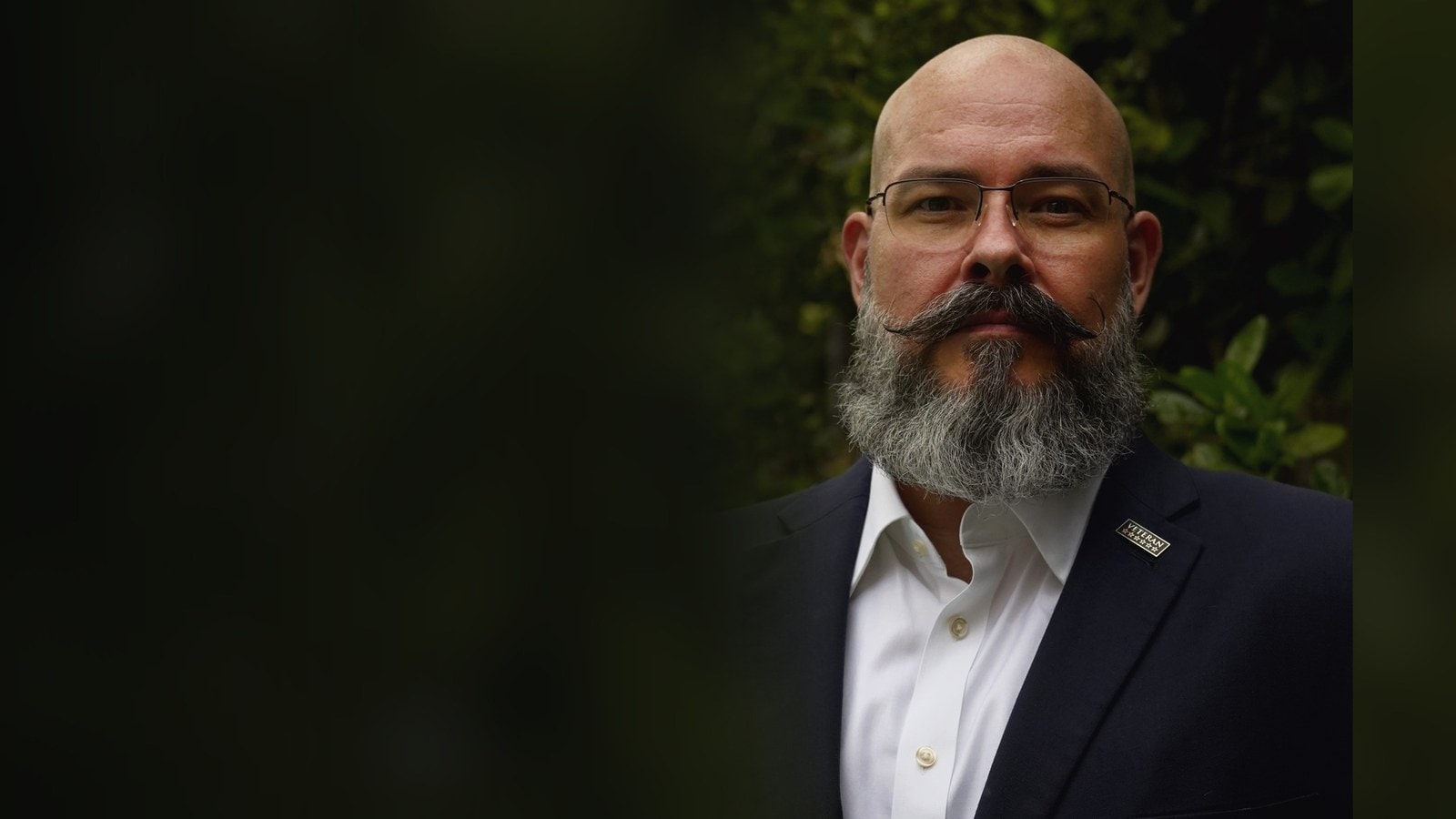
A 10-year-old in a bookstore. A paratrooper. A supplier-diversity executive who bet a company on good weather and lost it. Meet the man who now owns the magazine.
Forty-some years ago, a 10-year-old boy stood in a bookstore trying to find out what a word meant.
Not the definition. He needed to know what the word gay meant for him, what it meant to be different, to stand outside the group while standing in the room. There was no language for it then, nowhere to see role models, nobody to ask. So, he went to the one place that didn't require permission, only the skill to read: print.
What print gave him back was ugly. Lascivious stories. Villainy. A world that had filed an aspect of human expression under perversion. "I did not see the heroes," Brian Auden says. "I did not see the warriors. I did not see the pioneers. I did not know they existed."
In August 2025, that boy, now an entrepreneur, a service-disabled veteran, founder and CEO of Valor Force Solutions, bought Affinity Inc magazine. Not because the category was booming. It wasn't. Corporations were walking back diversity commitments in public and scrubbing certain words from their websites to comply with a new U.S. administration that was and is still not keen on the concept of diversity, equity, and inclusion (DEI). He bought it because of what happened the first time he read Affinity Inc, long before founder Don McKneely's search for the magazine's next home brought the two men together.
"I saw that 10-year-old find his heroes," Auden says. "A potential future in a world where he could be accepted, and even thrive."
What He's Inheriting
The magazine Auden now publishes turns 14 this year. McKneely, chairman of TexCorp Communications and the publisher behind MBN USA and WE USA, launched Affinity Inc after a chance conversation at a diversity conference in upstate New York with Justin Nelson, co-founder of the National LGBTQ+ Chamber of Commerce (NGLCC).
The first cover featured Nelson and NGLCC co-founder Chance Mitchell. Fortune 100 companies told McKneely that if he launched it, they'd support it, and they did. Fourteen years and more than 100 industry awards later, Affinity Inc had become the publication of record for LGBTQ+ business enterprise.
But McKneely, on his own account, always carried a quiet asterisk. "I've always felt that Affinity Inc really needed to be owned by an LGBTQ+ entity," he told Affinity Inc Editor-in-Chief Diane Sears in an article published during the transition, "because, although I'm an ally, I'm not a member of the community."
Read that against the story about the boy and the bookstore, and the weight of this handoff comes into focus. For 14 years, the beacon was built and tended honorably, and to real effect, by an ally. It now belongs, for the first time, to someone it was built for. The boy who couldn't find heroes in print now owns the press.
The boy who couldn’t find heroes in print now owns the press.
McKneely, for his part, did not hand over the keys and leave. "My goal is to walk lockstep with Brian," he says. "I'll share with Brian, 'OK, this is the way I would recommend we do it, and I'll tell you why,' and then he can choose to go that route or take another route. He is starting with a winning formula."
Which is where it gets interesting. Because the new publisher, who reveres what he's inheriting, does not entirely agree that the formula should survive intact.
Under the new rules of the road, with government agencies, corporations, and small businesses trying to play it safe in a business climate where "diversity" has become taboo, a publication built around diversity and inclusion has to adjust its course.
But it will still carry out the intent of the mission: to portray business leaders who can serve as role models for other people aspiring to fit into a world that is not always black-and-white … and also not always rainbows.
There is a price on this new formula. Who pays for the lights while the market shifts and maneuvers to stay inside the new "safe space"? Auden does. "I'm covering the cost out of my own pocket, for as long as I can," he says. You will notice this flagship issue carries no paid advertising. That was intentional: the partner pages in this edition were placed by the publisher, not sold. Paying advertisers are welcome in the new chapter, "but we will be clear, be kind, and be honest."
The 40 Years in Between
The distance between the boy in the bookstore and the man writing that check is four decades, and Auden does not narrate them as a wound. He names them and moves on. "I understood domestic and public violence. I understood sexual violence. I understood discrimination and sexism. I understood poverty. I intimately understood those things before I understood what a beer tasted like." That is the entire account he offers, and it is enough. He isn't asking the reader to feel something. He is showing his credentials.
Auden's career started in recruiting, at the moment the internet was rewiring how hiring worked. Auden saw immediately what the technology actually meant for people like him.
"Now you would be recruited on skill set, not bias. On achievement, not ZIP code. That was the magic of the 'blind resume.' You would be known before you would be seen." It didn't end bias, as there was always the post-interview "culture fit" call, but the doors were open. "Some of us were getting the job. And that was thrilling."
Then the Twin Towers came down in New York City in a series of events that would later be memorialized as 9/11. At age 27, Auden was working internally for Rockwell Automation supporting the Americas Talent Acquisition team in modernizing and optimizing hiring practices. He promptly quit that career and volunteered, joining the Army as a combat engineer and paratrooper completing a tour in Afghanistan, service he counts among the proudest accomplishments of his life.
What he found inside the uniform was another culture with its own hierarchies of belonging, including a familiar one: "In the queer community, we see those who say, 'I'm gay, but I'm not that gay. I'm inclusive, but I can't go that far.'" His answer to all of it has the flatness of something long settled: "When we wake up in the morning, each of us sees a human being staring back in the mirror."
What he found when he came home was worse. The country that tied yellow ribbons on trees had turned PTSD into a headline and veterans into a hiring risk. "Thank you for your service. I'm sorry we can't use you."
So, the recruiter with a decade of noted experience and an honorable discharge rebooted his career in a kitchen, one that hired felons working their way back, cleaning grease traps and scraping plates. He tells this part without varnish and without self-pity, and it explains more about the publisher he's become than any title he's held since: He knows exactly what it feels like when the system that promised to judge you on merit finds a new reason not to.
The climb back led to a decade inside one of the world's largest managed services provider (MSP) firms, TAPFIN, where Auden screened suppliers and built supplier diversity solutions. He logged thousands of supplier conversations across all industry sectors and client types, all from a front-row seat.
He can provide direct experiential insight into the hidden costs small businesses don't see coming: the certification fees, the gatekeeping, the payment terms that starve a company waiting on money it has already earned. His advice to suppliers from those years still comes out like a reflex: "Don't give it away. Don't undercut your pricing. If your service is meritable, you'll get the contract."
Few people have run his particular lap around the supplier ecosystem, in all its different roles: the kid who was excluded, the recruiter who was constantly challenged, the young executive polishing his craft, the soldier who was strengthened, the veteran who was rejected, the CEO who was emboldened, and now the board member for multiple organizations who is constantly evolving.
The community has noticed. Matt Pavelek, president and CEO of the National Veteran Owned Business Association (NaVOBA), calls Auden someone who is "an outstanding board member and an incredible advocate for NaVOBA."
Ask Auden himself what the board seats are for, though, and the answer starts somewhere unexpected: "They make all of it worthwhile. All of the experiences, from every facet, relevant. Bearable. Worthy." Then the working part: "I can say what is difficult to say, in the way that the audience can hear it and process it."
It's a version of what McKneely saw across the table before the handoff to the new publisher. "Brian is such a dynamic individual. I believe he has the passion for where I'd like to see Affinity Inc go," the founder says. "He's a builder, much like I've always been, bringing together people and communities."
The Bet He Got Wrong
Everything to this point, Auden survived. What comes next, he caused, and he is the one who insists on the distinction.
Coming out of the MSP years, he built a staffing company called Superbeo, and he built it as a pure expression of everything he believed: focused entirely on diversity engagement, the metrics, the culture work, the community development, the ROI data that showed corporations exactly what minority, disability, veteran, and LGBTQ+ engagement returned. It worked.
Superbeo won award after award and grew from zero to $6 million in revenue in a very short tenure.
Then the U.S. administration changed, and a company that was fluent in the words "diversity" and "equity" got flagged as problematic. "The market shift left us standing outside again," Auden says. He sold his interest.
"I built a company whose entire value depended on a political climate persisting, and I didn't hedge that bet," he says. "I read the awards and the revenue as proof the model was durable, when they were proof the weather was good. That misread cost me the company."
“I read the awards and the revenue as proof the model was durable, when they were proof the weather was good.”
Where the Stories Stop, and the Contracts Start
One more thing Auden wants on the record, because readers would find it anyway and he'd rather they hear it from him: He is also the founder of Mesh-IQ, a new platform built to connect certified businesses to live purchasing opportunities.
"Affinity Inc tells stories. It provides visibility. That's where it stopped," he says. "True connection, true engagement with buyer intents, RFIs, RFPs, that's where success is won or lost. The story is the celebration. The success is the invitation to the party."
He structured Mesh-IQ as a standalone corporation, and he is its founder, not its CEO. He has handed off that title to someone experienced at leading a tech company, while Auden oversees the parent corporation. Affinity Inc will support Mesh-IQ as it would any venture opening doors of opportunity for the certified community, he says, "but we will maintain a distinct line between Mesh-IQ and Affinity Inc."
A Human Affinity
A lifetime in supply chain and community building taught Auden how the real work has always happened: quietly. It happens in the hands of people who give whole careers to supplier development, working humbly with whatever the circumstances allow, adapting, evolving.
Many have lost those careers, and more, in the shift; many others carry the disquiet of a culture moving beneath them. Yet these are the people making sure everybody has a seat at the table, so that the best product or service, one that truly meets the community's demands, is available.
To them, he speaks directly. "We see you. We see those who are toiling tirelessly to ensure we all have representation, we all have a seat at the table, and we all have the opportunity to shine. As a human family, it takes all of us to hold the community together."
“We see you. We see those who are toiling tirelessly to ensure we all have representation.”
He knows that today, many of those champions, the individuals, organizations, brands, and NGOs, cannot celebrate or be celebrated publicly, for fear of persecution or exclusion. And he wants them to know he understands exactly what is at stake.
"Adopting that persecution or exclusion model would ripple far beyond them or an entity's P&L," Auden says. "It would impact our families, our communities. It would impact our loved ones, the humans reliant upon them, and the corporations for financial security now and in the future. They are holding the line for us all."
"We are grateful for those who have supported Affinity Inc for the past 14 years, and we understand poignantly the challenges they face today," he says. "They have our commitment that we will continue to support them as well. We welcome you in whatever capacity you can continue that journey with Affinity Inc. We welcome you, and we celebrate you.
"We may think we are divided. We may think we have differences. But those are thoughts, that is not reality. Regardless of where you come from, who you aspire to be, what your role is: When you look in the mirror, you see a human being. We are all members of the human family."
That, he says, is the meaning of the name on the cover. "That is the definition of affinity. Here, we have a human affinity."
The Next Chapter
So, what does the reader actually get, whether that reader is the business owner deciding in a shrinking market if any of this still deserves hope, corporate leaders who ponder the work of outreach and inclusion, or the 10-year-old standing in whatever is today's version of that bookstore?
"Affinity Inc has been and will continue to be the bridge of community to opportunity," Auden says. "We will share the 'cheat codes,' the insights. The battles won and the lessons learned. The battles lost and the cost. We will find and celebrate our best people. We will find our customers. We will find our suppliers. We will find and support each other, so that if any one aspect of the market pulls away or shrinks, we are holding each other."
It is not a promise that the water gets calmer. It is a promise about who is in the boat. Auden's readership doesn't need to be told the moment is hard; they are living it. What they need is what a 10-year-old needed in a bookstore 40 years ago and didn't find: proof, in indelible print, that people like him and them have walked, crawled, stumbled through it and are still here, still building relationships, still winning contracts on merit that, as he puts it, "those who are faking it simply can't make."
McKneely built that proof for 14 years as an ally and says he knows how the story goes from here: "I know Brian is going to do very, very well with the magazine." The new publisher's own promise is narrower, harder, and entirely in character for a man who pays for the pages himself.
"We will not flinch. We will not look away. And we will shine."
Beacons are not free. He knows exactly what the light costs. He has been paying for it, one way or another, since he was 10.
Disclosure: Brian Auden is the founder of Mesh-IQ, a separate corporation referenced in this article. Affinity Inc maintains editorial independence from Mesh-IQ and from its advertisers.