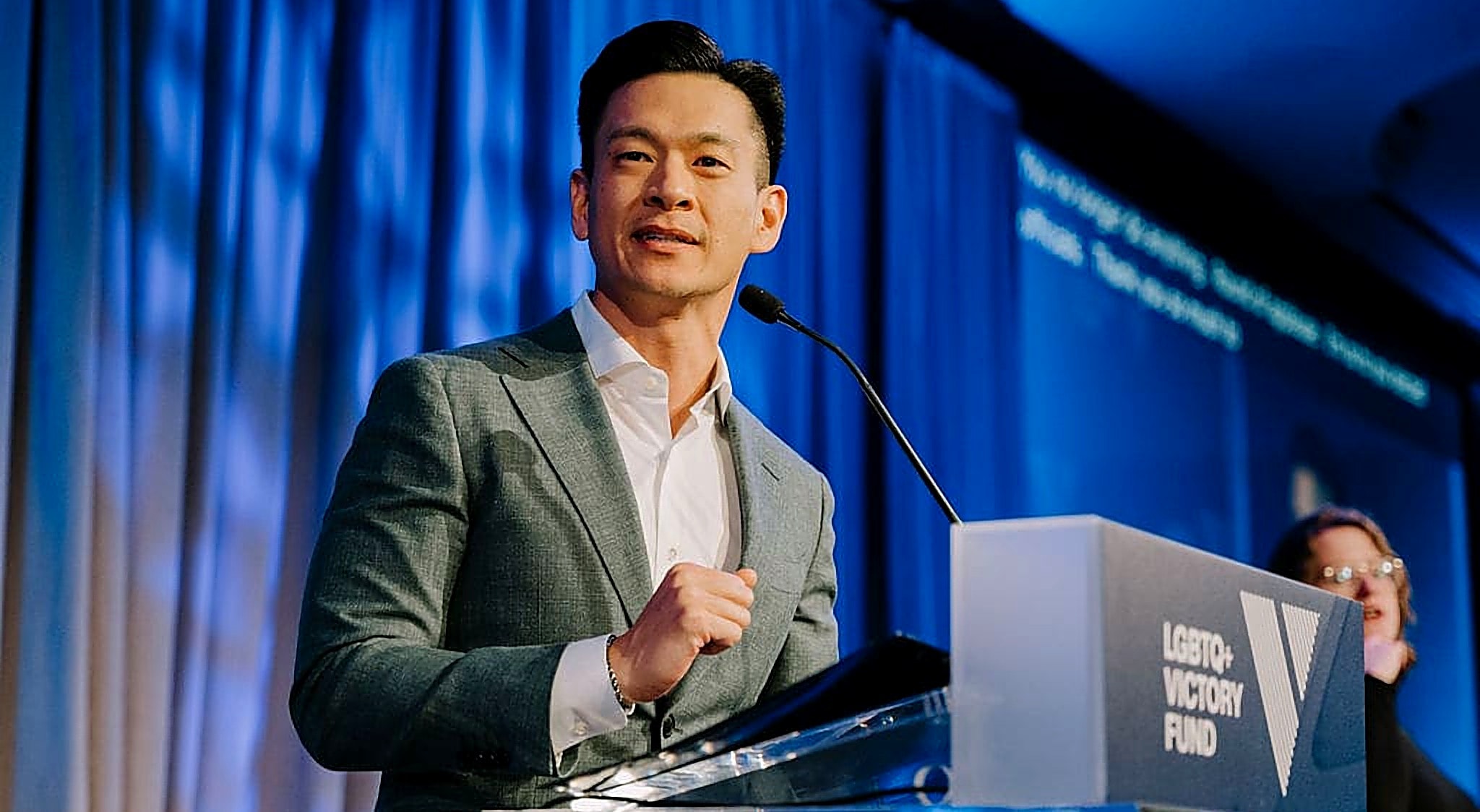
How a 21-year-old city council candidate who lost by one point became CEO of the LGBTQ+ Victory Fund, and why he says the backlash is producing more candidates, not fewer.
When Evan Low talks about leadership, he rarely starts with power. He starts with people.
“I fundamentally believe in representation,” he says. “It is harder to legislate us out of existence when we are in these key positions.”
For Low, CEO of the LGBTQ+ Victory Fund, that belief is not theoretical. It is rooted in lived experience, in the contradictions of serving as a mayor who could officiate weddings but not get married himself, of leading a city while being barred from donating blood, of carrying both the pride and pressure of being a fourth-generation Asian American navigating politics, culture, and identity all at once.
“It is harder to legislate us out of existence when we are in these key positions.”
Low stepped into the CEO role in March 2025, at a moment when LGBTQ+ rights were coming under renewed attack and political rhetoric had turned increasingly hostile, especially toward transgender communities.
“This is one of those moments in history where you might think people would pull back,” Low says. “And instead, what we’re seeing is the opposite. We’re seeing nearly three times as many LGBTQ+ candidates stepping forward.”
That surge, quiet, determined, and deeply hopeful, is at the heart of Low’s vision for the Victory Fund’s next chapter.
An Unexpected Path to Public Life
Low jokes that his political ambitions began earlier than he remembers.
“I don’t remember this conversation,” he laughs, “but my mother said that I wanted to become president.”
Growing up, politics was hardly the expected path. As an Asian American, Low was raised in a cultural framework where stability and traditional professions were prized.
“In our Asian culture, you’re supposed to become a doctor or a lawyer or an engineer,” he says. “That was the definition of success, certainly not politics. My mom reminds me of that.”
By his own description, Low is an introvert. The idea that he would someday become one of the most visible LGBTQ+ political leaders in the country was far from inevitable.
What changed wasn’t ambition. It was understanding.
In college, Low enrolled in a political science course that shifted his perspective entirely.
“I learned more about what a city council was, what local government actually does,” he says. “Here’s how your roads get built. Here’s who governs water and infrastructure and public safety and building height.”
For the first time, governance felt tangible to him. It also felt personal.
“I realized I had opinions about what businesses should be in my local communities, about how to get more grocery stores, how to have affordable housing,” he says. “That was something I cared about deeply.”
From Classroom Theory to the Ballot
That spark turned into action through a senior thesis project that would alter the trajectory of Low’s life. As part of an internship with the mayor of his city, Low conducted a detailed analysis of what it would take to run for city council, mapping stakeholders, neighborhood groups, and local issues.
“And then I said, ‘Why don’t I actually run instead of just doing this theoretically?’” he recalls.
At 21 years old, Low launched his first campaign.
“I didn’t know any better,” he says with a smile.
He lost that race … by just 1%. Rather than retreat, he doubled down. At 23, he ran again, and this time he won.
From there, Low served eight years as a city council member and mayor, followed by a decade in the California Legislature. Along the way, he built a reputation as a pragmatic leader focused on housing, infrastructure, and economic opportunity, issues that resonate far beyond identity politics.
Finding Victory, and Being Found by It
Running openly as an LGBTQ+ candidate two decades ago, even in California, came with real risk.
“It was not the easiest thing to do,” Low says. “And in many places, it still isn’t. It can be perceived as a political liability.”
That’s where the LGBTQ+ Victory Fund entered his life. “At the time, a supporter told me, ‘If you’re running, there are different groups you should engage with. Victory Fund is one of them.’”
The organization didn’t just offer endorsement. It offered something more lasting.
“They helped coach me, guide me, and provide best practices on how to live an authentic life, how to be truthful about who you are without hiding,” Low says.
When he lost his first election, the Victory Fund didn’t disappear. “They were there to pick me up and throw me right back in.”
The Victory Fund also invested in Low as a leader, enrolling him in the David Bohnett Leaders Fellowship, which sent him to Harvard Kennedy School’s Senior Executives in State and Local Government program.
“It’s one thing to run for office,” Low says. “It’s another thing to govern: to exude leadership, to be a good steward of public trust. Those are different skill sets.”
Low doesn’t hesitate when asked why the organization’s mission resonates so deeply with him.
“I am a beneficiary and a product of Victory,” he says. “That’s why I feel so passionate about this work.”
Leadership Shaped by Lived Experience
Low’s approach to leadership is inseparable from the inequities he has witnessed firsthand.
“When I served as mayor, I could officiate a wedding as a government official,” he says. “But I could not get married myself.” He could host a blood drive but not donate blood. He could mentor Boy Scouts but not serve as a member.
“These are lived experiences,” he says. “And they provide the lens for what we’re doing now.”
That lens shapes Victory Fund’s core belief that representation is not symbolic, it is structural.
“Our mission is about building power for the LGBTQ community,” Low says. “It’s about advancing the so-called ‘gay agenda.’”
The phrase, often weaponized, becomes disarming in his hands. “When people say ‘the gay agenda,’ I say, ‘I’m glad you asked. Let me tell you what we’re advancing.’”
He pauses, then smiles. “Our gay agenda is about housing affordability, public education, clean drinking water, safe communities.”
“Our gay agenda is about housing affordability, public education, clean drinking water, safe communities.”
Leading in a Time of Backlash, and Momentum
Low became CEO in March 2025, stepping into leadership just as political attacks on LGBTQ+ rights escalated nationwide. “There are laws being proposed and passed that criminalize our existence in some states,” he says plainly.
Yet the data tells a counterintuitive story. In 2025, the Victory Fund endorsed more than 500 LGBTQ+ candidates for state, local, and federal offices. “And applications for our candidate training programs are nearly three times what they were before,” Low says.
Rather than discouraging participation, the hostility has galvanized it. “People are watching what’s happening, and they don’t want to sit on the sidelines,” he says. “They want to answer the call for service.”
For Low, that surge is both inspiring and operationally challenging. “It’s a good problem to have,” he says. “But it means we have to make sure we have the infrastructure to support them in meaningful ways.”
Reframing the Narrative
One of Low’s clearest priorities as CEO is elevating transgender leadership, especially in regions where misinformation runs rampant.
“There’s a narrative right now that trans candidates are a political liability,” he says. “I would argue they are an asset.”
“There’s a narrative right now that trans candidates are a political liability. I would argue they are an asset.”
He points to results. “Look at Sarah McBride in Delaware. Look at Olivia Hill in Nashville. Look at state legislators in Montana, Iowa, Virginia. These are red states.”
What do they have in common? “They focus on kitchen-table issues,” Low says. “Affordability. Health care. Economic opportunity.”
Visibility, he believes, is transformative.
“This is similar to how we won marriage equality,” he says. “People saw that we’re just like everyone else.”
The Organization Behind the Movement
Victory Fund’s work is powered by a dual structure: the Victory Fund itself, which supports candidates politically, and the Victory Institute, its nonprofit arm focused on leadership development and training.
LGBTQ+ Victory Fund
Endorses and supports out LGBTQ+ candidates running for office at every level of government.
LGBTQ+ Victory Institute
The nonprofit arm: leadership development, candidate and appointee training, and support once in office.
“They work hand in hand,” Low explains. “We identify leaders, support them, help get them elected, and then continue developing them once they’re in office.”
As demand grows, so does the need for volunteers, partners, and institutional support. “That’s what keeps me up at night,” Low admits. “Making sure we’re ready to meet this moment.”
What Business Leaders Can Do
For LGBTQ+ business owners and allies, Low sees engagement as both practical and powerful. “Get involved,” he says simply. “Join your chamber of commerce. Serve in leadership roles. Be visible.”
Those spaces matter more than many realize.
“By default, business associations interface with elected officials,” he explains. “Having LGBTQ+ leaders in those rooms strengthens everyone.”
Lessons from the Campaign Trail, for Entrepreneurs
Low draws a clear parallel between politics and entrepreneurship.
“Business owners are often so focused on keeping the lights on that they don’t have time to track every policy change,” he says.
That’s why relationships matter. “Know your local elected officials,” Low advises. “Not just when there’s a problem.”
Those connections can unlock access to grants, procurement opportunities, and resources that would otherwise be buried in bureaucracy.
“If you’re on your own, you become a number,” he says. “If you have an advocate, you get a human response.”
A Message of Hope and a Pipeline of Leadership
Despite the challenges, Low is deeply optimistic. “Fifteen years ago, our goal was representation in all 50 states,” he says. “Then it was one openly LGBTQ+ U.S. senator.”
Now the pipeline includes multiple Senate candidates, congressional leaders, and even potential presidential contenders.
“Remember where we were,” Low says. “Know where we are. And look at where we’re going.”
“Remember where we were. Know where we are. And look at where we’re going.”
For him, the future isn’t abstract, it’s already in motion.
“We are resilient,” he says. “And these aren’t just words. These are facts.”
The Road Ahead
Victory Fund hosts events across the country throughout the year, welcoming supporters, allies, and future leaders alike.
“You don’t have to run for office to make a difference,” Low says. “Just show up.”
For a leader who once stumbled into politics through a college class, showing up has become a calling, and an invitation.
As Evan Low looks ahead, his message is clear: Representation isn’t just about who holds office. It’s about who believes they belong there.
And right now, more people than ever are raising their hands.
All artwork in this article was created by Affinity Inc. The charts and diagrams illustrate figures and descriptions given by Evan Low in this interview.