
This story appears in The Digital Issue, Volume 1, 2026
Read the full edition →Home›From the Publisher's Desk
From the Publisher's Desk
A Place to Meet, Not Just to Read
A new mark, a rebuilt site, the Affinity Inc Exchange, and 14 years of archive you can finally search.
You are reading the web version. This story appears on page 8 of the print edition. Open the flipbook
For 14 years, affinityincmagazine.com did one thing, and did it well. It published stories.
You arrived, you read about a business owner who had built something, you closed the tab. The site was a magazine that happened to live on a screen. For most of those years, that was the right answer.
It is not the answer now.
The businesses in these pages do not need one more place to be admired. They need places to be found, by each other and by the people who buy. So the site has been rebuilt from the ground up, around a different question: not "what should our readers see," but "what should our readers be able to do?"
A Mark That Shows the Work
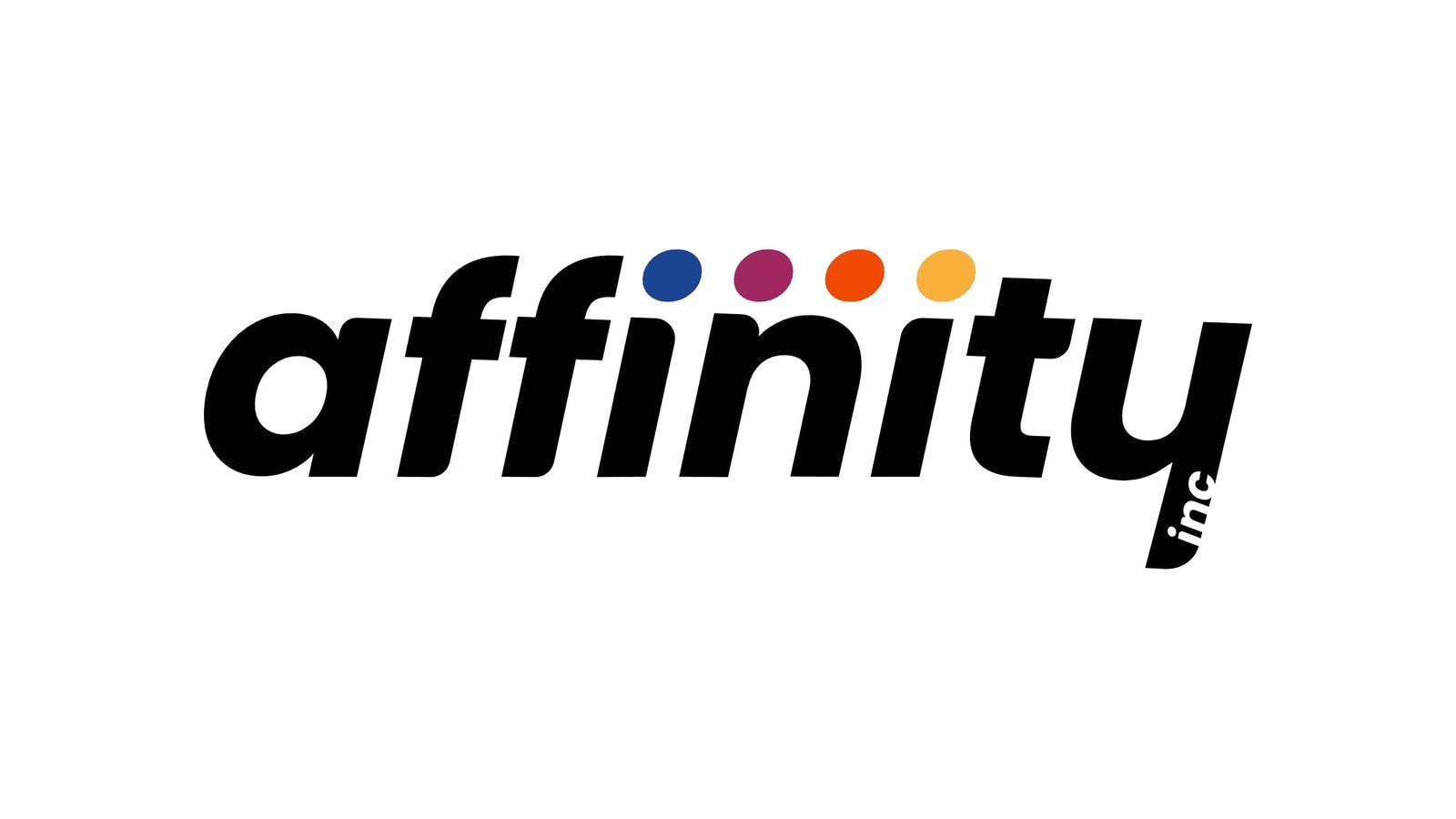
Start with the logo, at the top of this page, because it says the rest of it in one glance.
Look at where the four dots actually sit. They are not decoration floating above the name. They are the dots of the letters, and read that way, they are people. Each i is a person: a dot for a head, a stem for a body, turned slightly toward the one beside it. And the n in the middle is two people with an arch between them. Two figures, joined.
So the mark says something very specific. Four people. The middle two are already connected. The outer two are not yet. They are turned toward the others, waiting to be introduced. Four colors, no two alike, every one the same size, standing on a line that climbs left to right.
Take the dots away and affinity is not just misspelled. The people are gone. They are load-bearing. The word does not work without them, which is as good a statement of editorial policy as we could have drawn on purpose.
That gap between the connected pair and the ones still turned toward them is not a flaw in the drawing. It is the job. Introducing the people who have not met yet, closing the space between the i standing alone and the n where two are already joined, is the whole reason this magazine exists, and the whole reason for the Exchange described further on.
Notice what is not there. No dot is larger. No dot leads. Not a corporation reaching down to a supplier: neighbors on the same line, at the same height, going up together. That is what the word underneath them means. Affinity is the pull between people who recognize something of themselves in one another. We are not an audience. We are a community.

What Changed on the Page
The redesign is not decoration. Four things are different in ways you will feel within 10 seconds.
It is fast, and it reads. Type set for actual reading rather than for a design award. Clear hierarchy, generous measure, real contrast. On a phone, the story starts immediately instead of eight scrolls below a stack of banners.
You can find things. Stories are indexed by industry, by certification, by region, and by the organizations covered. If you are looking for the piece about the veteran-owned logistics firm in the Southeast, you can get to it in one search instead of scrolling a reverse-chronological feed until you give up.
Every story is a doorway. Read about a company you like, and everything you need in order to actually call them is right there: what they do, what they are certified as, where they work, and how to reach them. Until now a feature ended with a compliment. Now it ends with a phone number.
It works on whatever you have. A new phone, an old laptop, a hotel wifi connection that barely deserves the name. Which brings us to the part we care most about.
The Affinity Inc Exchange
Here is the actual news.
The Exchange is a place inside affinityincmagazine.com where the businesses in this magazine can find one another and do business together: directly, without a gatekeeper, an intermediary, or a fee for the privilege of being introduced.
The premise is simple enough to state in a sentence: the fastest customer for a small business is often another small business. Everyone in this ecosystem spends years learning to sell upward, into the Fortune 500, through certification and portal registration and long procurement cycles. That work matters and it is not going away. But while a supplier waits 18 months for a corporate contract to clear, they are also buying legal services, printing, IT support, staffing, catering, insurance, freight, and software. And they are usually buying all of it from firms that have no connection to this community at all.
That is not a moral failure. It is an information problem. You cannot buy from a company you have never heard of.
“You cannot buy from a company you have never heard of. The Exchange exists to close that gap.”
The Exchange is built on two ideas that carry equal weight.
Trade. Members list what they sell and what they buy. Certified companies and corporations can even exchange services based on value, and in an economy where costs are in flux this offers another path to collaboration and shared growth. Other members can find them by capability, certification, and location, and contact them directly. No lead fees, no pay-to-appear rankings, no algorithm quietly sorting by who spent the most.
Mutual support. Commerce is the floor, not the ceiling. The Exchange is also where members share the things that are worth more than a referral and are almost never written down: which certifications were worth the cost, which payment terms to refuse, who actually answers the phone at a given supplier-diversity office, how to price a bid you have never priced before. Every business owner in this community has learned some of this the expensive way. Very few have had anywhere to put it.
Those two halves are not separable. A directory without a community becomes a stale list. A community without commerce becomes another networking group. Together they are the thing this ecosystem has needed for a decade and kept substituting galas for.
Meridian Freight & Logistics
Charlotte, North Carolina · 34 employees · Member since 2026
LGBTBESDVOSBSmall Business
Sells, Regional LTL and truckload freight · Warehousing and cross-dock, 40,000 sq ft · Final-mile delivery, Carolinas and Virginia
Buys, Commercial insurance and bonding · Fleet maintenance · Bookkeeping and payroll
Open to, Subcontracting on regional bids · Teaming for contracts above capacity · Mentoring newer carriers
3 live buy requirements matched this week · Contact directly →
Built for Everyone, and We Mean the Whole Sentence
The new site is fully accessible. Every part of it works for people who do not use a website the way most of us do.
We are putting this in the announcement instead of the footer for a reason. This magazine spends every issue arguing that people should not be shut out of rooms. It would be a strange thing to say that in a room half our readers cannot get into.
About one in four adults in this country lives with a disability. When a website does not work for them, it is not an inconvenience. It is a closed door with our name on it.
In practice that means a few unglamorous things. If you use a screen reader, it will describe our photographs to you properly, because someone sat down and wrote those descriptions. If you cannot use a mouse, you can still reach every corner of the site. If your eyes are tired or the sun is on your screen, the text still holds. If you are deaf or hard of hearing, the videos are captioned. If you are colorblind, nothing important disappears.
What that means in practice
- A screen reader describes our photographs properly, because someone wrote the descriptions
- Every video is captioned
- You can reach every part of the site without a mouse
- Text holds up on a tired pair of eyes or a sunlit screen
- Headings are ordered so the page can be scanned, however you read it
- Forms ask for things in plain words
- Nothing important disappears if you are colorblind
None of that is clever. It is just care, applied on purpose, and most of accessibility turns out to be exactly that. We will keep at it, too, because a badge you earn once and never look at again is precisely the sort of gesture this magazine has stopped accepting from everyone else.
14 Years, Now Searchable
The last piece is the archive.
Every edition of Affinity Inc is now online and searchable in full, all of it, back to the first cover.
This matters more than it sounds. 14 years of this magazine is 14 years of a record almost nobody else kept: who was building what, which corporations showed up and when, which promises were made in which year, and which of them held. It is an institutional memory for a community that has been told repeatedly to start over.
It is also, frankly, a receipt. In a period when a great deal of language is being quietly revised, an archive that cannot be edited after the fact is a useful thing to own.
Search it by name, by company, by year, by subject. If you were in these pages in 2014, you are still in these pages.
Where the Exchange Meets Real Demand
The Exchange tells you who is out there. It does not, on its own, tell you what anyone is buying this quarter.
That is where our expanded partnership with Mesh-IQ comes in. Mesh-IQ surfaces live buying opportunities: a company that needs a specific thing, by a specific date, with money already set aside for it. Not an invitation to register and wait, which is what most of this ecosystem has offered suppliers for years.
The difference is bigger than it sounds. Most of what a supplier gets offered is visibility: a listing, a profile, a badge, a spot in a directory somebody may never search. Visibility is nice. It does not pay anyone. What actually helps is knowing that a real company needs a real thing next quarter, and that you are qualified to go after it.
A buyer posts a real requirement
A real company needs a real thing, by a real date, with money set aside.
It is matched to capability
Against what you actually do and what you are certified as. Not a keyword guess.
The supplier bids
Knowing the work is real, and that you belong in the running for it.
So Exchange members see opportunities matched to what they genuinely do, and buyers reach a certified supplier base without having to go hunting for one. Business between members, and business from the larger companies, same road, two directions.
Disclosure, stated plainly. Mesh-IQ was founded by Brian Auden, the publisher of this magazine. It is a separate corporation with its own chief executive; he does not run it. Affinity Inc will support Mesh-IQ as it would any venture that opens doors of opportunity for this community, and it will maintain a distinct line between the two, the same line described in this edition's profile of the publisher. Editorial coverage in this magazine is not for sale, to Mesh-IQ or to anyone else. Readers can and should hold us to that.
Thirty Days
One piece of housekeeping, and it has a clock on it.
For 30 days from the launch of the new site, advertisers can lock in preferred placement and reduced rates, both the partners who have carried this magazine for years and those coming in for the first time.
There is no mystery to why. A relaunch is the one moment when everything is genuinely open: positions that are normally spoken for, placements in the new site architecture, presence in the Exchange as it fills. Once those are taken, they are taken, and rates return to card.
If you have advertised with Affinity Inc before, your renewal holds your existing position and your rate is reduced, tell us which position you held and we will hold it. If you have not, this is the widest the door will be.
30 days from launch
Preferred placement and reduced rates, then rates return to card.
How to claim it
- Rate card and placement map: affinityincmagazine.com/advertise
- Email: Sales@affinityincmagazine.com, ask for the launch window rate.
- Renewing partners: mention the position you held last year and it will be held for you.
What This Is For
None of this is a redesign in the sense that word usually means. The type is better and the pages load faster, and both of those are worth having. But the point was never a nicer website.
The point is that a magazine can tell you a business exists, and that is where a magazine's job has always ended. What happens next has always happened somewhere else, if it happened at all: the introduction, the quote, the contract, the advice passed between two people who needed the same thing at different times.
Now it can happen here.
Four people on a rising line. Two of them already connected. The other two are the reason we are still working.
The relaunch, in four parts
A mark. Four people on a rising line, two connected, two yet to be.
A site. Fast, findable, and every story ends with a phone number.
An Exchange. Members trade and support each other, no gatekeeper, no lead fees.
An archive. 14 years, searchable in full, back to the first cover.
Four doors, one address
Read. Every story, indexed by industry, certification, and region, and built to be read on whatever you have.
Connect. Join the Affinity Inc Exchange: trade and mutual support, member to member, with no gatekeeper and no lead fees.
Remember. 14 years of archive, searchable in full, back to the first cover. If you were in these pages, you still are.
Hire. Help Wanted carries jobs, board seats, volunteer and pro bono work, and internships, free for certified businesses, nonprofits, NGOs and affiliates.
Visit
affinityincmagazine.com to explore the new site, join the Affinity Inc Exchange, and search the full archive.
For preferred placement and launch-window rates: affinityincmagazine.com/advertise, or Sales@affinityincmagazine.com